Hidden Senses / Anatomy of attention
Reading an Ocean We Cannot Feel
We see a sheet of blue. A shark encounters a layered place: pressure changing, chemicals drifting, tiny electric fields flickering close by.
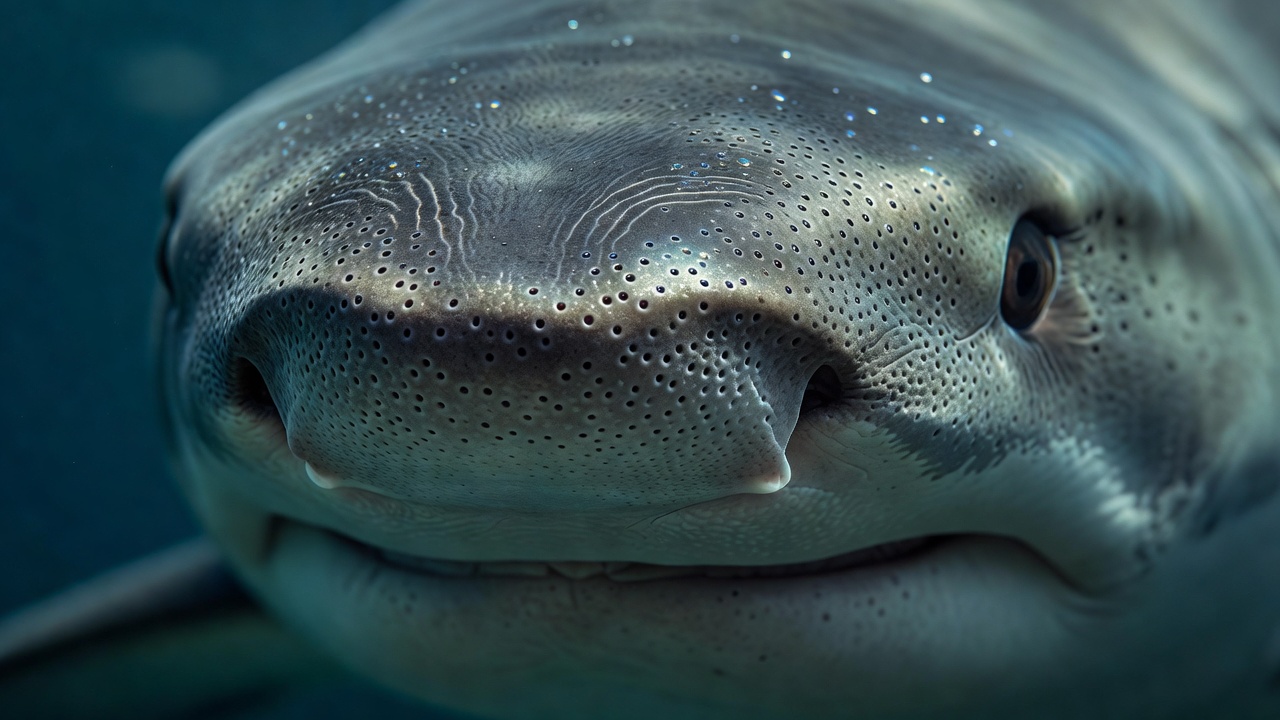
01 / Electricity at close quarters
A signal beneath the sand
A hidden animal is not necessarily a silent one.
Muscle and nerve activity produce weak electric fields. In sharks, gel-filled canals link external pores to sensory organs called the ampullae of Lorenzini. These organs can detect faint electrical signals and help sharks locate prey at close range, including prey concealed in sediment.
This is not a long-distance radar sweeping the ocean. Detection depends on the signal, the surrounding conditions and the animal. Close-range prey detection is well established; broader questions about how sharks use electrical and magnetic information during navigation remain under investigation.
A hidden animal is not necessarily a silent one.
02 / Movement without an image
The water touches back
The lateral line is a mechanosensory system running along the body and onto the head. Its receptor cells respond to nearby water movements, adding information about disturbances in the shark’s surroundings.
Think of a ripple as a temporary footprint. It does not tell the whole story on its own, but it gives an animal another way to find, orient and respond.
Evidence / Not a superpower
Remarkable does not mean limitless.
There is no single meaningful distance at which all sharks can detect “a drop of blood.”
Detection depends on the chemical, its concentration, currents and the species involved. A scent plume is a shifting patchwork, not a straight line drawn from a shark to its source. Precision makes this story more interesting, not less.
03 / More than one channel
Eyes, nostrils, ears—and context
Sharks can see, smell and hear. Many have a reflective layer behind the retina that helps make use of available light, but visual abilities differ among species and habitats. Sharks’ nostrils primarily serve smell rather than breathing; water for respiration passes over the gills.
Sound travels efficiently through seawater, and sharks can respond to underwater sounds. Which cues matter most depends on the animal and the situation. A sensory system useful near a dark seabed may be used differently in clear surface water.
Find these adaptations in three species →
Follow the evidence
- Smithsonian Ocean: sharks and their sensory biology
- Florida Museum: shark research and educational resources
Sensory descriptions here are general introductions. Capabilities and behavior vary across species.